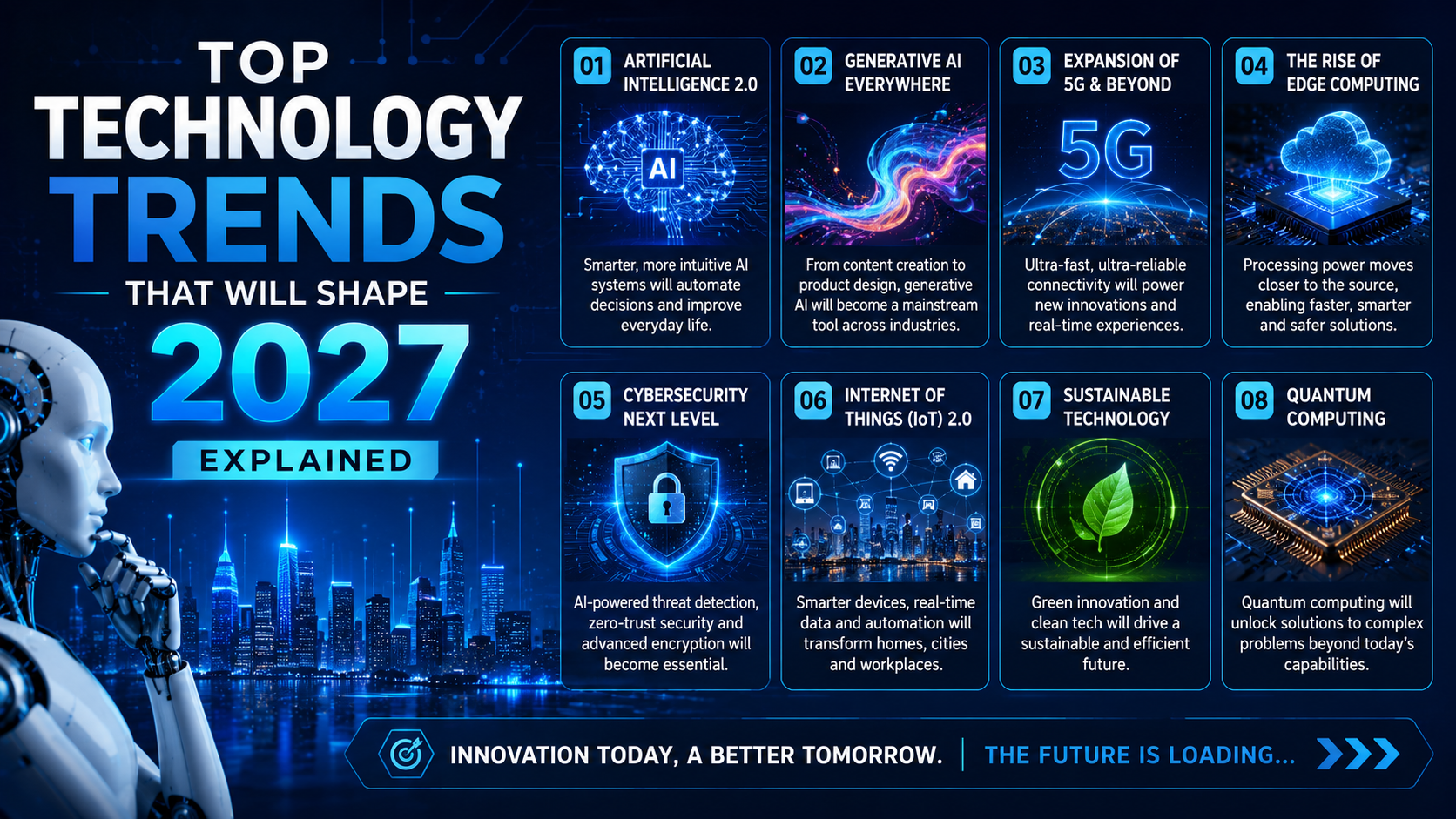
Discover the Top technology trends that will shape 2027, from AI and quantum computing to robotics, cybersecurity, and green technology shaping the future.
What will technology look like in the next few years? The Top technology trends that will shape 2027 are set to transform the way we live, work, and communicate. From AI and robotics to quantum computing and green technology, innovation is moving faster than ever. Let’s explore the biggest technology trends that could define the future. You can also explore TechNewzTop for more technology updates, insights, and the latest information on emerging tech trends.
Top Technology Trends That Will Shape 2027
Technology is changing at a rapid rate and is impacting our work, learning, communication, and business. Technologies such as artificial intelligence, automation and smart computing are now integral to daily life.
To prepare for the future, students, professionals, and businesses need to be aware of the Top technology trends that will shape the year of 2027. This article will showcase the most significant technology trends that will change the world and all of our lives by 2027.
Why 2027 Will Be a Landmark Year for Technology
There are going to be a lot of changes in the next few years when it comes to digital transformation. All businesses around the globe are spending vast amounts on smarter software, intelligent machines, secure digital systems and cloud infrastructure. Governments also are encouraging innovation to enhance public service and economic development.
There are a number of factors promoting the technological development:
- Rapid improvements in artificial intelligence
- Faster internet and connectivity
- More powerful computer processors
- Growth of cloud computing
- Increased demand for automation
- Increased awareness of cybersecurity.Increased focus on cyber security.
- The cultivation of sustainable technologies which facilitates investments.Investment in sustainable technologies.
The developments are paving the way towards an era of technology that is smarter, more connected and more efficient than ever before.
What Are Technology Trends?
Technology trends are innovations that are introduced and will be accepted in the coming years because they solve a problem or solve a process. Some trends vanish after a brief time and others revolutionise industries.
For instance, the smartphone revolutionized communication, cloud computing revolutionized data storage, and AI is revolutionizing the way companies work. The most powerful technologies for 2027 will likely have an even more profound influence given their interdependency to boost productivity, security and user experience.
1. Artificial Intelligence Will Become More Advanced
In 2027, artificial intelligence (AI) is projected to be the most significant trend in technology. AI today can generate images, analyze massive amounts of information, answer customer inquiries, write content, and automate repetitive tasks. Future systems of AI will be even more powerful.
AI will become a more vital tool for businesses seeking to enhance decision-making, cut down on costs, and provide tailored customer experiences. AI will also enable doctors to diagnose diseases more quickly, teachers to develop personalized learning plans, and businesses to better predict market trends.
Some expected improvements include:
- Smarter virtual assistants
- Faster data analysis
- Better language translation
- Personalized recommendations
- Intelligent business automation
AI will not completely replace humans, but will be used in conjunction with them to enhance productivity and efficiency.
2. AI Agents Will Handle Complete Tasks
Among the Top technology trends that will change the course of 2027 is the emergence of AI agents. AI agents can carry out workflows without human intervention, and they’re not limited to answering questions, as with traditional chatbots. They can interpret information and make decisions in accordance with instructions; they can carry out several activities from one end to the other.
Schedule Meetings
AI agents can automatically schedule appointments, meetings, and send out meeting invitations without having to do them manually.
Organize Emails
They can organize their mailboxes, prioritize important emails, compose responses and more.
Generate Business Reports
With AI agents, you can gather data, analyse performance and generate comprehensive reports in mere minutes.
Compare Product Prices
They are able to type in a number of websites and compare the prices, which lets businesses and consumers make wise purchases.
Manage Customer Support
By handling customer inquiries, resolving common problems, and offering round-the-clock support, AI agents reduce the need for manual work and free up human personnel to focus on more complex tasks.
Track Project Progress
They can track work, keep projects on track, send reminders, and assist teams stay on track.
With the advancement of AI agents, companies will save precious time, boost productivity, and enable staff to dedicate more time to creative and strategic tasks.
3. Quantum Computing Will Open New Possibilities
One of the promises of quantum computing is that it can solve problems which are too complex for traditional computers.
Quantum computers would use qubits, which would allow them to manage very complicated calculations much quicker than standard computers, which do this using bits. This technology is still in the process of development, but experts believe there will be a lot of changes in 2027.
Some industries that could benefit from quantum computing include:
- Medical research
- Drug development
- Climate prediction
- Financial modeling
- Scientific simulations
- Logistics optimization
With ongoing research, quantum computing may be one of the biggest and most impactful technologies of the decade to come.
4. Hyperautomation Will Improve Business Efficiency
Automation is not just confined to repetitive work. Hyperautomation is a blend of artificial intelligence, robotic process automation (RPA), machine learning and advanced analytics for automating entire business processes.
Rather than implementing automation to individual processes, organisations can link together multiple systems that automatically work together.
For instance, if a customer orders online, the system can automatically carry out the following functions:
Verify Payment
The system assures the customer’s payment securely before the order is processed.
Update Inventory
It automatically updates the stock levels to make sure that stock records are accurate.
Generate an Invoice
A digital invoice is automatically generated and sent to the recipient, without human involvement.
Schedule Shipping
The system automatically determines the best shipping method and packs orders for delivery.
Send Order Notifications
You can send instant notification to customers about their order status via email or SMS.
Update Business Reports
Sales and transaction information is automatically captured in business reports, for easier tracking and analysis.
This eliminates manual labour, error reduction, quickens business processes and enhances customer satisfaction.
Hyperautomation is projected to have the greatest impact on industries like banking, healthcare, manufacturing, and retail and logistics.
5. Cybersecurity Will Become More Intelligent
With the development of digital technology, cyber threats are becoming more sophisticated. Safeguarding big information will be one of the top concerns for companies around the world.
AI will play a significant role in future cyber security systems, helping to detect any sort of suspicious activity before it can actually cause serious damage.
By 2027, some of the top cybersecurity innovations anticipated will be:
- AI-powered threat detection
- Zero Trust security models
- Multi-factor authentication
- Automated security monitoring
- Real-time fraud prevention
- Stronger data encryption
Businesses will continue investing in cybersecurity because protecting customer data is essential for maintaining trust and meeting regulatory requirements.
6. Extended Reality (XR) Will Change Learning and Entertainment
Extended Reality (XR) is a blend of Virtual Reality (VR), Augmented Reality (AR), and Mixed Reality (MR) technologies that create immersive digital experiences. XR will become more available and affordable in various industries by 2027.
Virtual Education
Students can participate in interactive virtual classrooms to make the learning process more interesting and accessible, regardless of location.
Medical Training
Medical students and physicians can perform advanced medical procedures in a virtual environment in a realistic manner without treating a real patient.
Product Demonstrations
Retailers can highlight products in 3D, and offer customers the chance to see features and imagine products before buying.
Gaming and Entertainment
XR will enable more interactive entertainment platforms, virtual concerts and more immersive gaming experiences.
Employee Training
XR can be utilized to offer practical training in a secure and lifelike setting, enhancing employee skills and confidence.
Remote Collaboration
Groups can interact and collaborate in a more interactive way, even when they are working remotely.
In the educational, healthcare, business, and entertainment sectors, XR technology can enhance digital experiences, making them more engaging, useful, and accessible.
7. Digital Twins Will Improve Smarter Decision-Making
A digital twin is a virtual representation of a real object, machine, building or even city. They gather real-time data using sensors and mimic its behavior with various scenarios.
The digital twin will be a crucial asset for companies in 2027 due to its ability to decrease risks, enhance productivity and minimize maintenance expenses.
Digital twins can be used by companies to:
- Monitor equipment performance
- Predict machine failures
- Test changes before implementation
- Improve manufacturing processes
- Reduce downtime
The technology is expected to be used in a variety of industries, including healthcare, construction, aviation, manufacturing, and smart cities.
8. Edge Computing Will Deliver Faster Performance
With billions of connected devices generating huge amounts of data, it’s not the most efficient way to send everything to a remote cloud server.
With edge computing, data is processed at the edge of the network, minimizing latency and enhancing performance.
Faster Data Processing
By processing the data close to the source, the devices can react more rapidly without having to wait for cloud servers.
Lower Network Latency
By minimizing latency, edge computing enables real-time applications such as smart factories and autonomous vehicles to operate more efficiently.
Better Privacy Protection
Sensitive data can be locally processed, which helps to minimize the amount of personal data which needs to be transferred across various networks.
Reduced Bandwidth Usage
Only data that is deemed necessary is sent to the cloud, which can help to reduce bandwidth usage and increase network efficiency.
Improved Reliability for Smart Devices
Edge computing enables IoT devices to run even if there is limited or unreliable Internet access. The technology will have a significant impact on the fields of self-driving cars, industrial automation, medical monitoring and Internet of Things (IoT) applications.
9. Robotics and Autonomous Machines Will Become Everyday Tools
Robotics is moving out of the factory. Today, robots are more intelligent, flexible and are able to perform complex tasks with less human involvement.
Robotic technology is one of the Top technology trends that will impact 2027 and is likely to change many industries.
Examples include:
- Warehouse automation
- Delivery robots
- Agricultural robots
- Medical assistance robots
- Hospitality service robots
- Home cleaning robots
Robots will assist people by performing repetitive tasks and physical work of low value, which will free them up to engage in creative and decision-making activities.
10. Green Technology Will Support a Sustainable Future
Sustainability in the environment is gaining importance all over the world. Companies are investing in green technology to decrease carbon emissions, energy usage and waste. Green innovation is set to increase dramatically in many industries by 2027.
Renewable Energy Systems
Cleaner power generation and a reduction in reliance on fossil fuels will be achieved through solar, wind and other renewables.
Electric Vehicles
The growth of electric vehicles (EVs) will continue with a view of decreasing greenhouse gas emissions and fuel consumption.
Smart Energy Management
Energy management systems equipped with AI will maximize the use of electricity, minimize losses, and enhance energy efficiency.
Eco Friendly Manufacturing
Manufacturers will implement sustainable production processes that aim to reduce waste, use resources as efficiently as possible and limit environmental damage.
Carbon Tracking Software
These carbon tracking tools will be employed by businesses to track emissions, monitor sustainability goals, and meet environmental regulations.
Energy Efficient Data Centers
Advanced cooling systems and energy-saving technologies will be implemented in modern data centers to minimize energy usage without compromising on performance.
Businesses implementing sustainable technologies can reduce their operating expenses, fulfill environmental objectives, and foster customer confidence in the company’s commitment to sustainability.
11. Blockchain Will Expand Beyond Digital Currency
Although blockchain is known to be a technology behind cryptocurrencies, it can benefit a lot more than payments.
Many industries benefit from the ability of a blockchain to maintain secure, transparent and tamper-proof records.
By 2027, blockchain could be widely used for:
- Supply chain management
- Healthcare records
- Digital identity verification
- Smart contracts
- Financial transactions
- Secure document management
Blockchain is one of the most promising technologies for the future with its ability to enhance transparency and security.
12. 6G Research Will Shape the Next Generation of Connectivity
Though 5G is still rolling out across the globe, the study of 6G networks is picking up speed. Early 6G advancements could come with some exciting enhancements by 2027.
Ultra Fast Wireless Communication
6G is projected to offer even greater speeds of internet connectivity, facilitating faster downloads, smoother streaming and quicker data transfers.
Lower Latency
The 6G network will enable real-time applications like autonomous vehicles, remote surgery, and industrial automation, due to its extremely low latency.
Better Support for AI Powered Applications
6G’s faster and more efficient speeds and capacity will enable more efficient and instant data processing for AI devices and services.
Enhanced Virtual/Augmented Reality Experience
6G will offer high-speed connectivity, enabling more immersive VR and AR applications and enhancing virtual experiences.
Enhanced Communication Between Smart Devices
The implementation of 6G networks will enable the seamless connectivity of smart homes, connected vehicles, wearable devices, and Internet of Things (IoT) systems, enhancing their speed and reliability.
Although it may be a while until the technology becomes widely adopted, 6G research will provide the building blocks for digital innovation of the future and next generation of connected technologies.
13. Human Augmentation Will Improve Health and Productivity
Human Augmentation: Technologies that augment physical or cognitive abilities through advanced digital systems.
Examples include:
- Smart wearable devices
- AI-powered health monitoring
- Advanced prosthetic limbs
- Brain-computer interface research
- Smart vision and hearing assistance
These innovations can lead to improved health care, workplace safety and accessibility, and quality of life. Human augmentation is likely to be a more practical and useful technology in the future as technology advances.
Industries That Will Benefit the Most
These are the Top technology trends, which will shape 2027, and will make almost every industry look different.
Healthcare
Patient care will be enhanced through the use of AI diagnostics, robotics, wearable devices, and digital twins, which will allow the implementation of more effective, quicker, and accurate treatments.
Education
Education will be personalized and accessible, with AI tutors, virtual classrooms and immersive learning platforms.
Manufacturing
Increased productivity and cost reduction will result from robotics, automation, and predictive maintenance in factories.
Finance
AI and blockchain will be used in banks and financial institutions to enhance fraud detection, automate customer service, and secure transactions.
Retail and E commerce
Retailers will provide a customized shopping experience by AI, AR and automation.
Transportation
Transportation will be safer and more efficient with autonomous vehicles, smart traffic systems and connected infrastructure.
Challenges of Emerging Technologies
Future technologies offer many benefits, but also have some drawbacks.
The greatest concerns are:
- Cybersecurity threats
- Data privacy issues
- High implementation costs
- Ethical concerns surrounding AI
- Workforce reskilling
- Government regulations
- Digital inequality
These challenges need to be overcome in a way that requires cooperation between governments, businesses, technology providers and educational institutions.
How to Prepare for the Future
As technology advances, lifelong learning is essential to stay current. It’s never too late or too early to get ready for tomorrow’s digital world, whether you’re a student or a working professional.
Understand the fundamentals of Artificial Intelligence
Having an AI basic is essential for navigating future workplaces where automation and smart systems are increasingly prevalent.
Develop digital and technical skills
Acquire the skills of cloud computing, data analysis, coding, and digital marketing, which are essential for being competitive in the job market.
Stay Informed About Emerging Technologies
Stay updated with trusted technology news, industry blogs, and online courses to understand the latest innovations and trends.
Develop problem solving abilities
The critical thinking and problem solving skills you develop will enable you to deal with new challenges and make good decisions in today’s technology-rich world.
Practice Cybersecurity Awareness
Practise safe online habits, secure and create strong passwords, use 2FA and safeguard personal and professional information.
Be ready to use new tools and systems
The world of technology evolves rapidly, and being willing to embrace new digital tools, platforms, and software will enable you to advance your career.
People who are open to lifelong learning and always striving to further their education and skills will have a better chance at the future career path and technological changes.
Conclusion
Artificial intelligence, automation, robotics, blockchain, and other innovative technologies will revolutionize industries in 2027 as the Top technology trends. With the continuous advancement of technology, individuals and businesses need to adapt to it and learn new skills to remain competitive. Today’s preparation is the ultimate key to success in tomorrow’s technologically driven world.
Frequently Asked Questions (FAQs)
- What are the Top technology trends that will shape 2027?
The major trends include artificial intelligence, AI agents, quantum computing, robotics, digital twins, edge computing, blockchain, green technology, cybersecurity, and extended reality.
- Why are technology trends important?
Technology trends help individuals and businesses understand future innovations, prepare for industry changes, and remain competitive in a rapidly evolving digital world.
- Which industry will benefit the most by 2027?
Healthcare, manufacturing, finance, education, retail, and transportation are expected to experience significant improvements through advanced technologies.
- Will artificial intelligence replace human jobs?
AI will automate many repetitive tasks, but it is also expected to create new career opportunities in technology, data analysis, cybersecurity, AI development, and digital transformation.
- How can students prepare for future technology trends?
Students should focus on learning AI, cloud computing, cybersecurity, data analysis, digital marketing, and other digital skills while staying updated on emerging technologies to remain competitive in the future job market.