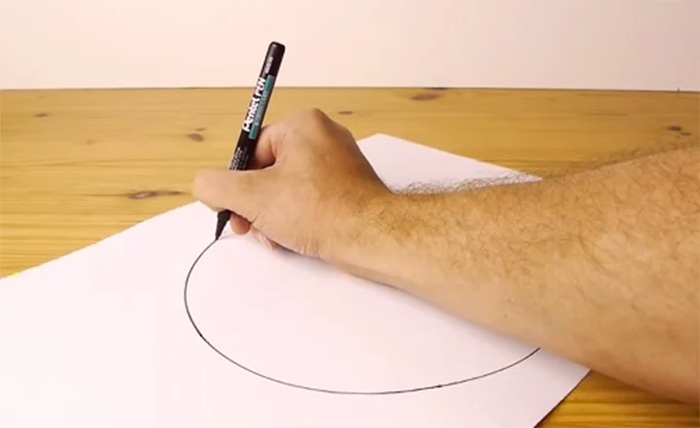
To draw a perfect circle is often considered one of the hardest basic drawing tasks, even though a circle looks simple at first glance. The challenge lies in maintaining equal distance from the center at every point while keeping your hand movement smooth and controlled. When artists try to draw a perfect circle freehand, even small inconsistencies become visible, making the shape appear wobbly or uneven. Learning to draw a perfect circle helps improve hand-eye coordination, muscle memory, and overall drawing confidence.
The desire to draw a perfect circle is not limited to artists alone. Designers, engineers, students, and even psychologists use circle drawing exercises to measure precision and focus. Because a circle has no corners or straight edges, your brain must constantly adjust motion, which is why mastering how to draw a perfect circle is both mentally and physically demanding.
Draw a Perfect Circle Using Basic Hand Techniques
One of the most common ways to draw a perfect circle is by using controlled hand movement rather than relying on wrist motion. Artists are often taught to move their entire arm from the shoulder instead of the wrist when attempting to draw a perfect circle. This technique allows smoother motion and reduces sharp angles or sudden stops that distort the circle’s shape.
Practicing slow, continuous motion is essential if you want to draw a perfect circle consistently. Start by sketching lightly and rotating your paper instead of your hand. This method helps maintain even curvature while reducing strain. Over time, repeated practice trains your muscles to remember the circular motion, making it easier to draw a perfect circle naturally without thinking too much.
Draw a Perfect Circle with Simple Tools and Objects
If freehand drawing feels difficult, using tools is an excellent way to draw a perfect circle accurately. Common household items like coins, cups, plates, or bottle caps can serve as guides. By tracing around these objects, you can draw a perfect circle instantly while learning how proper circular proportions look.
Professional tools such as compasses, circle templates, and drafting instruments are also widely used to draw a perfect circle in technical drawings and artwork. While tools make the process easier, it’s still important to observe how the curve flows. Understanding this flow helps you later draw a perfect circle freehand with more confidence and precision.
Draw a Perfect Circle Digitally on Phones and Computers
In the digital age, many people try to draw a perfect circle using smartphones, tablets, or graphic design software. Most drawing apps include shape tools that automatically create a perfect circle with one tap. However, digital artists often practice freehand drawing even on screens to improve natural control.
When using a stylus or mouse to draw a perfect circle, zooming in can help refine details, but it can also exaggerate imperfections. Many programs offer “snap to shape” or “hold to perfect shape” features that convert rough sketches into smooth circles. Learning to draw a perfect circle digitally still requires practice, especially if you want your circles to look organic rather than mechanical.
Draw a Perfect Circle Through Daily Practice Exercises
Daily exercises are one of the best ways to learn how to draw a perfect circle consistently. Artists often fill entire pages with circles of different sizes, focusing on smooth motion rather than perfection. This repetition builds muscle memory and improves control over time.
A helpful exercise is ghost drawing, where you move your hand in a circular motion above the paper before actually touching it. Once the motion feels smooth, place the pencil down and draw a perfect circle in one continuous movement. Practicing this exercise regularly strengthens coordination and makes the process of drawing a perfect circle feel natural instead of forced.
Draw a Perfect Circle for Art, Design, and Education
Learning to draw a perfect circle has practical value in many fields, including art, architecture, engineering, and education. In art, circles are the foundation for drawing faces, eyes, heads, and complex shapes. When artists can draw a perfect circle, their sketches become more balanced and visually pleasing.
In education, teachers often ask students to draw a perfect circle as a coordination or focus exercise. Designers rely on circles for logos, layouts, and icons, where symmetry is critical. No matter the field, the ability to draw a perfect circle improves accuracy, structure, and overall visual quality.
Draw a Perfect Circle Without Fear of Mistakes
Many beginners struggle to draw a perfect circle because they fear making mistakes. This fear often leads to stiff movements and overcorrection, which actually makes the circle worse. Accepting imperfections is a crucial step in learning how to draw a perfect circle naturally.
Instead of erasing repeatedly, draw multiple circles quickly and confidently. Each attempt improves your understanding of shape and movement. Over time, your circles will become smoother and more symmetrical. Remember, even experienced artists don’t draw a perfect circle every time, but consistent practice makes near-perfect results achievable.
Conclusion
The ability to draw a perfect circle is more than just a fun challenge; it’s a powerful skill that improves precision, control, and artistic confidence. Whether you are drawing freehand, using tools, or working digitally, mastering the circle strengthens your overall drawing ability. The journey to draw a perfect circle teaches patience, discipline, and coordination, which are valuable in many creative and professional fields.
By practicing regularly, using helpful techniques, and letting go of perfectionism, anyone can learn to draw a perfect circle. With time and dedication, what once felt impossible becomes second nature, proving that even the simplest shapes can unlock deeper creative potential.
FAQs
1: Why is it so hard to draw a perfect circle?
To draw a perfect circle is difficult because it requires consistent motion, equal spacing from a center point, and strong hand-eye coordination.
2: Can anyone learn to draw a perfect circle?
Yes, anyone can learn to draw a perfect circle with practice, patience, and the right techniques.
3: Is it better to use tools to draw a perfect circle?
Using tools helps beginners draw a perfect circle accurately, but freehand practice improves skill and confidence.
4: How long does it take to draw a perfect circle freehand?
The time it takes to draw a perfect circle varies, but regular daily practice shows noticeable improvement within weeks.
5: Does drawing a perfect circle improve overall drawing skills?
Yes, learning to draw a perfect circle improves control, symmetry, and coordination, benefiting all types of drawing.