


Digital Provenance helps verify where digital content comes from, how it changes, and who handled it. Learn how it works, benefits, uses, and limitations.
Digital Provenance but how can you know where digital content really comes from? It reveals the hidden story behind images, videos, documents, and AI content. Every edit, change, and creator can leave clues about its digital journey. These details can make digital content easier to understand and verify. Discover why Digital Provenance is becoming essential for digital trust.
Digital Provenance: What Is It?
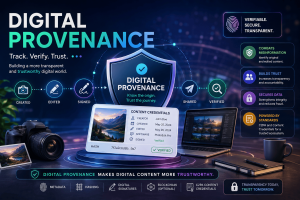
From its creation through the transformations, transfers, and activities that define its lifespan, Digital Provenance is the documented history of a digital asset. A digital asset is a picture, film, document, dataset, audio file, software file, or other kind of digital content. Provenance can show who made the item, when it was made, with what tools, who changed it, and how it traveled across systems.
Looking at the history of a really valuable piece of art can help one to rather quickly grasp digital provenance. One might better appreciate a painting’s past by documenting its artist, prior restorations, genuineness certifications, and former owners. Digital provenance uses a similar concept to digital products. It builds a history that enables customers to evaluate legality, ownership, changes, and accountability.
How Is Digital Provenance Made?
The process begins with the production of a digital asset. Early phases of a record may be recorded with metadata, tools, or digital signatures. The asset’s editing history, that is, cropping, editing, or combining pictures may also be tracked as it grows.
Cryptography improves security levels. Digital signatures enable identification of producers; cryptographic hashes help to draw attention to file modifications. A hash is a digital fingerprint. A little file modification can generate a new hash that helps to identify unapproved modifications.
This is the general procedure:
- Information about genesis
- Time and date observations
- Permissions or ownership
- modifying records of events
- Software or equipment employed
- Cross-platform moves
- Cryptographic identification
- Suitable tools or source materials
Taken together, these facts provide a digital asset’s traceable history.
Read more : WhatsApp images
Why Is Digital Provenance Important?
The internet has simplified copying, editing, and distribution of digital content. Generative artificial intelligence can also produce realistic images, sounds, and videos in only a few seconds.
Simple Digital Alteration and Duplication
Digital content may be immediately shared and edited. This makes it tough to distinguish whether a file is authentic or has been changed.
Problem Knowing Material Sources
Finding anything online does not guarantee its source. Digital provenance could help you find the history and source of something.
Better Research on Digital Content
Digital provenance doesn’t enable one to confirm whether something is true. It instead gives information on the material’s fate and source.
Origin Not Guaranteed
A provenance record could show the program changed or the picture’s creator. However, this does not show that every claim regarding the substance is accurate.
Content, credentials, and digital confidence
Content Credentials lets one learn about an asset’s past and modifications. Still, they are intended to highlight content history, not to evaluate whether the material itself is accurate.
Digital Provenance and AI Generated Content
Artificial intelligence has given provenance more importance than it has ever had. Writing, voices, videos, and lifelike photos can all be produced by artificial intelligence software. Customers might struggle to discern between actual video, a modified file, or AI-generated work without reliable information on how material was made. Digital provenance helps to explain the means and events used to produce content.
For example, an image could have provable indications showing:
- One specific instrument caught it.
- It was changed using certain tools.
- There was still another element used: a photo.
- Improvements came in stages.
- A well-known specialist signed the final edition.
- This kind of history can offer helpful context anytime content is shared or uploaded online.
What Are Content Credentials?
Among the major developments in Digital Provenance is Content Credentials. They are connected to the Coalition for Content Provenance and Authenticity (C2PA) and so assist to incorporate confirmed provenance data into digital material.
One can record the creation, changes, and related information of an asset using Content Credentials. They can also check this data using cryptographic signatures.
For instance, Content Credentials might record numerous arranged images as part of the asset history. This helps to more closely record over time how digital content has changed.
Essential Technologies Powering Digital Lineage
Provenance systems are aided by several devices.
Information regarding
Metadata lists the content of a digital file. It might have manufacturing time, equipment, device specs, or other descriptive notes information.
Metadata is not always sufficient to generate confidence as it could be changed or removed occasionally. For more thorough verification, it might be combined with cryptographic methods.
Worth of a Cryptographic Hash
Based on the content of the file, a cryptographic hash generates a unique-looking digital value. Usually the output hash will change if the file is updated. This allows changes to be found through hashing.
Electronic signatures
Digital signatures enable systems to verify whether signed data has been changed and help to connect content to a signature.
Strong signing identity and a trust mechanism help to increase confidence in provenance information.
Immutable Records and Blockchain Technology
Since distributed ledgers can offer unchangeable records, certain provenance systems also make use of blockchain.
Not every provenance solution calls for blockchain, though. Tracking digital history can also be done with metadata standards, signatures, databases, and other tools.
Information provenance vs. digital provenance
These two phrasings are related even if they include many aspects of digital data. This section concentrates on the origins of data and how it is transformed through several operations.
- Popular Uses: In addition to other applications, data provenance supports research, governance, data management, and analytics.
- Digital Provenance: Can track digital assets, their creations, changes, ownership, and technological settings, so broader.
- It may also track the systems, tools, and processes used across the lifetime of a digital asset.
- Technical, social-technical, and societal aspects of digital provenance show that a digital record’s history goes beyond only its data.
Useful Applications for Digital Provenance
Digital provenance would help many fields.
Communication and Media on Travels
Provenance data might help media outlets to give more background for pictures, videos, and other material. Since false facts and altered media spread fast, this might be quite helpful.
AI-generated content
Images made by artificial intelligence and other media may include provenance data demonstrating their creation or alteration. This offers buyers more background instead of left to wonder about the material’s source.
Digital archives content wise
Archives may better grasp born-digital information and the technological tools used to produce, store, and access it thanks to provenance.
From a historical perspective, the angle is more broad than just noting variances. It might comprise the systems, people, technology, and social factors that helped to shape a digital record’s development and maintenance.
Safety and business
Provenance data enable companies to investigate strange changes and improve accountability.
A full history will show what happened and which systems or people were involved should a major document or dataset be changed.
Advantages of Digital Pedigree
There are some significant advantages. Better openness enables consumers to learn more about the makeup and development of the material.
- Better realism checks: Cryptographic records help to more readily underline unauthorized changes.
- Less fraud: A documented past makes it possible to stop false portrayal of digital assets.
- More responsibility helps companies to know when and who took important actions.
- Improved material context for consumers could lie outside a file’s most recent look.
- Provenance supports copyright and attribution by documenting inventors, property, and asset past.
Splunk draws attention to the possible advantages of provenance systems in terms of transparency, fraud reduction, credibility, and higher user trust.
Digital Provenance: What Limitations Does It Have?
Though it could help one regain confidence, Digital Provenance is not the whole solution. restricted approval The best provenance solution is one the digital ecosystem helps to support. If cameras, editing software, websites, and social media networks either lack total provenance support or operate on several platforms, the chain might be broken.
Personal Issues
Site notes, tool notes, creator notes, or other personal information could make up provenance data. Therefore, companies have to carefully think about what data needs to be stored and who should be given access to it. Privacy Guides also calls attention to the serious privacy problems that happen when Content Credentials are put into use.
Source Could Be Removed
Software that ignores provenance policies runs the risk of missing or illegible provenance information. This might upset an usually prosperous historical trajectory.
Provenance Does Not Prove Truth
Maybe the most important limit is that provenance does not naturally make data accurate. It offers historical information and sources. People still have to consider the origin, background, and points related with the content.
What is ahead for digital provenance?
More acceptance, technical advancement, and privacy protection will determine Digital Provenance’s future course.
- More people should start utilizing standards including C2PA and Content Credentials since they enable various technologies and platforms to communicate
- By automatically detecting changes, recording produced information, and guiding customers, artificial intelligence systems can help them grasp provenance data.
- Better privacy: Privacy focused technologies like zero knowledge proofs can help certify data free of needless exposure of personal information.
- Cameras, editing programmes, artificial intelligence tools, browsers, and social media could all acquire provenance features.
- Acceptance of provenance might lead consumers to seek certified information on the provenance of digital content.
Final thought
Digital Provenance helps people find the origin, development, and people or tools used in digital content. Useful verification comes from tools like metadata, hashes, digital signatures, and Content Credentials as information made and changed by artificial intelligence (AI) grows. Still concerning are privacy, adoption, and lost data. Digital provenance helps to create online material trust.
FAQs About Digital Provenance
What is Digital Provenance in simple words?
Digital Provenance is the history of a digital asset. It can show where content came from, who created or changed it, what tools were used, and how the asset moved over time.
Does Digital Provenance prove that content is true?
No. Provenance can provide evidence about the origin and history of content, but it does not automatically prove that every claim within that content is true.
What are Content Credentials?
Content Credentials are a C2PA-based method for recording and verifying information about the origin and changes of digital content.
Is blockchain required for Digital Provenance?
No. Blockchain can be used for certain provenance applications, but provenance can also rely on metadata, cryptographic signatures, hashes, databases, and open standards.
Why is Digital Provenance important for AI?
AI can produce highly realistic digital content. Provenance can provide additional information about how content was created or modified, helping users better understand its background.
What is the biggest challenge with Digital Provenance?
One major challenge is widespread adoption. If different devices, applications, and platforms do not support compatible provenance systems, the history of a digital asset can become incomplete.