


Discover how World Models AI helps machines understand reality, predict future events, simulate actions, and make smarter decisions in real-world environments.
What if AI could understand the world and predict what happens next? World Models AI is teaching machines to understand reality instead of simply reacting to what they see. From intelligent robots to self-driving cars, this technology could transform how machines learn, plan, and make decisions. The fascinating part is how AI can simulate possible futures before taking action.
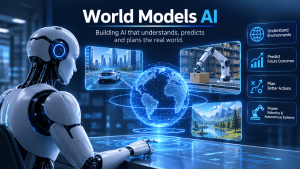
What Is World Model AI?
World Models AI is one kind of artificial intelligence that learns about how the world works and predicts possible future events. These systems create an internal representation of their surroundings and use it to predict possible results instead of merely reacting to data.
A warehouse robot, for instance, might find individuals and things and forecast what would happen if it went in a certain path using a world model. This enables the robot to render more wise decisions.
Said simply, conventional artificial intelligence could find what it sees; a world model enables artificial intelligence to grasp over time the behavior and changes of the surroundings.
How Do World Models AI Systems Work?
Based on images, videos, text, audio, sensor data, and robot movements, World Models artificial intelligence systems grow. Understanding an surroundings and projecting its likely growth depends on this information.
knowing the surroundings
First, artificial intelligence gathers data about its immediate surroundings. A self-driving vehicle might use cameras, LiDAR, radar, and maps; a robot might use movement sensors and cameras. This data helps the system to better grasp its environment.
Building Internal Representation
The technology then reproduces the interior environment. It emphasizes important information like objects, movement, impediments, and environmental changes instead of trying to recall every little visual detail. This enables artificial intelligence to better understand the current circumstances.
Estimation of Potential Future States
The world model then forecasts what might follow a certain action. For example, a robot could forecast what might occur should it halt, turn, pick up an object, or move forward. This helps the artificial intelligence to weigh several scenarios before answering.
Choosing an Action
At last, the artificial intelligence chooses an appropriate action based on these predictions. This sets a never-ending cycle of observation, analysis, prediction, preparation, and action. Artificial intelligence could go over this process again and change its decisions as the environment changes.
Read more : AI Agent Permissions
World Models AI vs Traditional AI
Conventional AI and World Models AI serve varied purposes. Whereas world models want awareness of surroundings and prediction of what may come next, regular artificial intelligence usually concentrates on identifying data or producing responses. Usually, reactions to a particular input such as identifying a car in a photo or producing an answer to a question.
- Artificial intelligence called World Models develops interior knowledge of an environment and forecasts likely changes.
- Traditional artificial intelligence can identify something without knowing its true life behavior.
- One can think of a thing’s position, movement, and potential consequences of many activities using World Models Artificial Intelligence.
- World models are quite helpful for self-driving cars, robots, and other systems that have to interact with the outside world.
- Most of the time, classic artificial intelligence concentrates on recognition and response; world models on knowledge, prediction, and planning.
This makes World Models artificial intelligence a need for embodied and physical artificial intelligence.
Why are artificial intelligence world models so important?
World Models artificial intelligence may assist devices to better grasp situations, forecast likely results, and improve judgment without full dependence on real-world trial and error. This enables artificial intelligence programs to be more powerful, safe, and capable of operating under trying circumstances.
Improved Decisions Making Ability
World models let artificial intelligence predict likely results before acting. The system might think about a few choices and choose a more appropriate path of action instead of responding right away.
Better Instruction
Before engaging with the actual world, artificial intelligence can investigate challenging or hazardous situations in virtual environments. For robots and self-driving cars, where repeated errors may be fatal or expensive, this is extremely helpful.
Improved Learning
A world model enables artificial intelligence to learn from intended or simulated experiences rather than just from actual contacts. This helps one to get some skills with less trial and error.
Improved Generalizability
A good world model finds more general trends in the surrounding behavior. This may enable artificial intelligence to manage new events unlike those it saw during training.
Robotics World Models AI
Robots have to know their surroundings and project the effects of their actions; hence, robotics is the most interesting application of World Models artificial intelligence.
World Models’ Assistance for Robotics
- The robot can recognize individuals, objects, dangers, and other important aspects of the surroundings.
- It can facilitate discovery of an item and learning how to get to it.
- One may use the world model to forecast what might occur when the robot swings its arm or changes direction.
- The robot can consider several possibilities and pick an appropriate course of action.
- By forecasting results before acting, the robot helps to reduce needless experimentation.
- Should the surroundings change, the robot may modify its following behavior and update its knowledge.
World models can also help robots to rehearse many scenarios in virtual or learned surroundings before they act in the real world. This helps more precisely physical thinking and streamlines robot training.
Self-Governing Vehicle World Models Artificial Intelligence
Self-driving cars have to be able to scan their surroundings and estimate what might happen next. By simulating possible future circumstances before acting, World Models artificial intelligence can enable autonomous systems to make better decisions.
Approximating Automotive Movement
A car has to be aware of another car’s potential for slowing down, stopping, speeding up, or simply continuing. One may use a world model to predict these probable actions.
Walker and Rider Awareness
Pedestrians and riders might turn quickly. World models enable an autonomous vehicle to suitably respond and estimate its probable movements.
Knowledge of Traffic Conditions
Road conditions, traffic signals, unexpected impediments, and construction zones can all impact driving decisions. Using this data, a world model can generate a more thorough view of the current state.
Modeling Potential Scenarios
Rather than just responding after something occurs, the system can consider many other scenarios before acting. For strange, challenging, or maybe hazardous driving circumstances, this is especially helpful.
World Models AI in Gaming and Virtual Worlds
World models are also starting up new interactive alternative digital settings. Rather than separately designing every component of one, artificial intelligence might identify patterns in how environments behave and produce or replicate fresh encounters. Modern techniques have tried to build interactive surroundings from prompts, photos, and other input sources. This might help consumers to more rapidly create dynamic games and design virtual settings.
This could finally help game developers:
- quicker changes in the environment.
- changeable gaming environments
- AI-generated scenarios
- Interactive models
- More unusual meetings
World Models AI vs Large Language Models
Large language models and world models are related to AI, but they focus on different types of understanding. An LLM primarily works with sequences of tokens and is highly capable in language-related tasks. A world model focuses more directly on representing environments and predicting how they change.
| Feature | Large Language Models | World Models |
| Main focus | Language | Environment dynamics |
| Common inputs | Text and multimodal data | Video, sensors, images, movement, and more |
| Main prediction | Next token or response | Future environmental state |
| Main use | Language and reasoning tasks | Planning and physical interaction |
| Example applications | Chatbots and coding | Robotics and autonomous systems |
However, these technologies do not necessarily need to compete. A future AI system could combine an LLM for high-level instructions with a world model for physical planning and environmental prediction.
Difficulties of World Models Artificial Intelligence
World models have promise but are not perfect. The real world is very complicated. A model might have a skewed or erroneous picture of its surroundings.
One of the biggest issues is:
accuracy
An artificial intelligence agent could make a terrible error if the model forecasts the wrong result.
Computational Needs
Training complicated global models could call for a lot of data and a lot of computing capability.
Long-distance weather outlook
The model’s attempt to look far into the future might build up little forecasting mistakes.
Real-world actual difficulty
Real surroundings offer unexpected events, shifting conditions, and interactions that might be difficult to precisely reproduce.
Safety
Bad forecasts can have actual effects if global models run physical systems. Therefore, testing, observation, and safety systems still are perfectly essential.
Point of view of the Models of the World Artificial Intelligence
Physical and embodied intelligence will greatly influence World Models AI going forward. These technologies could become increasingly relevant as artificial intelligence infiltrates real life.
- World models enable robots to more automatically interpret their surroundings, predict results, and accomplish chores.
- They might help autonomous systems to better grasp motion, forecast movements, and generate safer movements.
- Artificial intelligence could help researchers, tests, and training create more realistic and engaging surroundings.
- Future world models could help artificial intelligence to grasp movement, objects, space, and cause-and-effect relationships more thoroughly.
- Using world models helps robots to plan movements and adapt their actions as their surroundings evolve.
- Adding different artificial intelligence methods with world models could produce tools able to forecast, plan, and operate in difficult environments.
Artificial intelligence ought finally to go beyond merely producing material. It should be able to imagine likely outcomes, seize the surroundings, and act in response.
Final thought
World Models artificial intelligence is the first first stage towards more creative and more capable equipment. Therefore, by enhancing virtual simulations, autonomous cars, and robotics, it assists artificial intelligence in analyzing the surroundings and forecasting probable results. Though problems including accuracy, computer expenses, and safety still remain, world models could be rather important for artificial intelligence going forward since they will help robots to see, project, plan, and act.
FAQs About World Models AI
What are World Models AI?
World Models AI are AI systems that learn an internal representation of an environment and use it to predict how that environment may change after different actions.
Why are world models important?
They can help AI systems predict outcomes, plan actions, learn more efficiently, and reduce dependence on real-world trial and error.
How are world models ai different from LLMs?
LLMs primarily focus on language and token prediction, while world models focus on representing environments and predicting their future states. Both can potentially work together.
Where are world models ai used?
Potential and current applications include robotics, autonomous driving, gaming, virtual environments, simulation, and physical AI.
Can world models replace large language models?
Not necessarily. World models and language models solve different problems. Future AI systems may combine both technologies so that an LLM handles high-level instructions while a world model helps with environmental prediction and physical planning.