


Learn how Digital Twin Technology works, including its types, benefits, applications, AI integration, challenges, and future impact across different industries.
What if you could monitor a real-world machine, building, or entire city through a digital version of it? Digital Twin Technology makes this possible by connecting physical assets with real-time data and intelligent digital models. From predicting machine failures to improving complex systems, this technology is changing how industries understand and manage the real world.
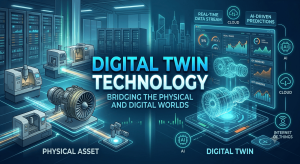
What Is Digital Twin Technology?
Digital Twin Technology is the creation of a digital replica of a physical object, process, system or environment. It is linked to the physical counterpart by means of sensors, IoT devices, software, and data networks.
For instance, temperature, vibration, pressure and performance data can be gathered via sensors on a manufacturing machine. This data is passed to the digital twin, so that engineers can virtually monitor the machine.
This information can be used to detect irregular changes and to forecast issues or failures before they occur through the help of AI and analytics. This is where Digital Twin Technology can be applied in monitoring, predictive maintenance, simulation, product development, and operational improvements.
How Does Digital Twin Technology Work?
In general, the role of digital twins is to ensure that there is a persistent relationship between the physical thing and the virtual counterpart. The process may differ in industry, but these are some of the key steps.
1. Data Collection
Information must first be gathered from the physical object or system. Important conditions like temperature, movement, pressure, location, energy usage and performance are measured by sensors and connected devices.
2. Creating the Digital Model
Information is gathered to develop a digital image of the physical asset. This model can contain the object’s structure, components, behaviour, and operation conditions.
The model can be a visual 3D model, a technical model, or a detailed model that can simulate the asset’s performance.
3. Connecting Real-Time Data
The more often or in real-time data is used in a digital twin, the more robust it will be. The link enables the virtual model to represent real-world changes.
If, for example, a factory machine begins to run at a different temperature, the digital twin can be informed of this and adjust its virtual temperature.
4. Analyzing and Simulating Data
Upon the availability of data, analytics tools, artificial intelligence and machine learning can analyze data. The digital twin can be utilized by organizations to explore and look into the current performance, as well as to test out scenarios of the future.
They can ask questions such as:
- What could happen if a machine runs at higher capacity?
- When might a component require maintenance?
- What would be the impact of a new design?
- What would happen if any component of a system failed?
These virtual experiments can help to lower testing costs and risk of making changes to real assets.
Read more : Filmyzilla 2025
Main Components of a Digital Twin
- Physical Asset: The physical object, machine, product, building or system being represented.
- Digital Model: Virtual model with information concerning the asset’s structure, behavior and performance.
- Sensors and IoT Devices: Gather real-time data and pass it on from the physical asset to connected systems.
- Data Platform: Processes, collects and structures the data, usually in a cloud format.
- Analytical skills and Artificial Intelligence: data analysis, pattern recognition, failure prediction and decision making.
- Visualization Tools: Dashboards, charts and the 2D/3D interfaces provide users with asset performance insight.
- Feedback Connection: Provides feedback and recommendations to the physical system for better operations and automation.
Types of Digital Twin Technology
Digital twins can be built in various levels, depending on the object a company wishes to track or analyze.
Component Twin
A component twin is one component of a bigger product or system. Each motor, valve, battery or pump can have its own digital twin, for instance.
This type is used to help the engineers observe how a particular component is performing and how it is being used.
Asset Twin
An asset twin represents a complete functional asset that may contain multiple components. A complete wind turbine or industrial machine could be represented as an asset twin.
It allows the users to grasp the working of the different components.
System Twin
A system twin is a collection of assets and an analysis of how they all interact. It might be the whole production line or a car or truck powertrain, for instance.
Such digital modeling can be used to find issues that are not apparent when examining parts of the system alone.
Process Twin
A process twin provides a wider view of an entire workflow or operation. It can be a manufacturing process or a supply chain, an energy network or a business operation.
It can help identify bottlenecks, optimize processes and document the impact of process changes on the overall process.
Benefits of Digital Twin Technology
- Predictive Maintenance: Tells the state of an asset and detects early warning signals, enabling teams to avert major failures.
- Minimized downtime: Regular testing and monitoring can help identify potential problems before they cause any damage, which can minimize unexpected equipment failures.
- Improved Decision-Making: Gives real-time data, lets organizations try out the potential impact of changes in a virtual environment.
- Reduces the need to keep going from the physical prototype to costly experiments and unwanted maintenance.
- Better Product Development: Supports engineers’ testing of designs, early problem detection and improved product development on a more efficient basis.
- Better Safety: Enables organisations to practice unsafe or hazardous scenarios virtually, which decreases the danger to humans or equipment.
Applications of Digital Twin Technology
Due to its ability to model various types of objects, systems, and processes, Digital Twin Technology is applicable to numerous industries.
Manufacturing
One of the most popular applications of digital twins is in manufacturing. Virtual machines, virtual production lines and virtual manufacturing processes can be developed in the factories.
Engineers can track equipment, identify bottlenecks, foresee maintenance requirements, and experiment with production modifications, without implementing them in the actual factory.
Healthcare
Digital Twin can be used in healthcare to analyze complex systems in research and medical practice. Medical devices, hospital operations and other medical processes can be analyzed using digital representations.
In the future, these more sophisticated digital twins could be used to assist in personalized analysis based on information on a specific patient. But privacy, security and data protection are very critical on this end.
Automotive Industry
Digital twins can be utilized in the design, testing, and monitoring of automobiles by automotive companies. Using a virtual vehicle model can assist a vehicle engineer in studying vehicle performance, energy usage, safety and component behavior.
Connected vehicles can also provide valuable data that may support maintenance and performance analysis.
Aerospace
Aircraft and spacecraft contain complex systems that require careful monitoring. Digital twins can help engineers study engines, aircraft components, and other systems throughout their operational life.
Virtual testing and continuous monitoring can support maintenance planning and help improve reliability.
Smart Cities
The digital twin can also depict a city. A smart city digital twin can fuse together information on traffic, buildings, energy consumption, transportation, etc., and more.
Simulations can be used by city planners to examine the potential impact of new roads, building projects or service changes.
Construction and Buildings
Digital twins can help monitor buildings throughout their lifecycle. A building’s virtual representation can include information about its design, energy consumption, equipment, and maintenance requirements.
This data can help facility managers be more efficient in their energy consumption and more effective in managing building systems.
Energy and Utilities
Digital twins can be leveraged to keep track of energy infrastructure, including power plants, wind turbines, solar installations, pipelines, and more.
The technology could enable organisations to gain insights into performance, potential problems and optimise energy operations.
Digital Twin vs 3D Model vs Simulation
| Technology | What It Does |
| 3D Model | Represents the appearance or visual structure of an object, but doesn’t necessarily relate to live data. |
| Simulation | Represents the possible behavior of a system in certain situations and can be used for testing the various scenarios. |
| Digital Twin | Relates a virtual representation to a real object or system and uses real-time data to monitor, analyze, predict and simulate. |
To sum up, a 3D model is the visual representation of an object, a simulation is an experiment to see what might happen and a digital twin is where the virtual representation of an object is tied to a real-world object via data.
Digital Twin Technology and Artificial Intelligence
- Data Analysis: AI can analyze vast quantities of data and find patterns that might not be apparent to humans.
- Predictive Maintenance: Machine learning can use past and current data to forecast future equipment issues.
- Anomaly Detection: AI can detect unusual behavior and help prevent potential issues.
- Performance Recommendations: AI can analyze system data, and make recommendations for improving performance and efficiency.
- Natural Language Interaction: Generative AI can enable users to input questions in plain English, and the AI will respond in a manner they understand.
- Quicker insights: Engineers can query the technical data and get useful insights from the AI-powered digital twin.
Challenges of Digital Twin Technology
While there are numerous benefits of Digital Twin Technology, it can be difficult to implement.
High Implementation Costs
For a sophisticated digital twin, sensors, software, cloud systems, data platforms and professionals are needed. The start-up costs for these requirements can be high.
Data Quality Problems
A successful digital twin is only as effective as the data that it receives. Garbage in, garbage out (GIGO) can diminish the accuracy of the digital representation.
Cybersecurity Risks
Digital twins can be a target for cyberattacks when they are connected to the internet. Access to sensitive systems or data can result in serious security threats if attackers are given access.
A robust security framework, access control, system monitoring, and frequent system updates are essential for organizations.
Integration Complexity
There are a number of organisation already using various software platforms and technologies. It can be technically challenging to integrate these systems with a digital twin.
Lack of Skilled Professionals
Digital twin projects typically involve an understanding of IoT, cloud computing, data analytics, artificial intelligence, engineering and cyber security.
It can be challenging to hire professionals with the right mix of skills.
The Future of Digital Twin Technology
- Digital twins will be even more connected: The number of IoT devices keeps increasing, making digital twins even more connected.
- More Real-Time Data: Connected devices and sensors will provide larger quantities of real-time data to future digital twins.
- Smarter Predictions: Improvements in AI and machine learning can augment the ability of digital twins to predict and recommend.
- More Industry Applications: Digital twins can now be used in smart factories, connected transportation, intelligent buildings, energy systems, and to support large-scale infrastructure.
- Cloud-Based Digital Twins: Cloud service can help organizations that are not capable of developing in-depth systems from the ground up.
- Improved focus on security: With increased adoption, security, privacy management, data management, and common standards will be more critical.
Conclusion
Digital Twin Technology is a technology that connects the physical and the digital world with real time data, sensors, AI and advanced analytics. It assists organizations detect assets, anticipate issues, enhance efficiency, and make more informed decisions.
The technology is promising, but it will need reliable data, robust cybersecurity and skilled individuals to implement. With technological development of AI, IoT, and cloud computing, Digital Twin Technology is anticipated to further grow in power in various industries.
Frequently Asked Questions
What Is Digital Twin Technology in Simple Words?
Digital Twin Technology creates a digital version of a real-world object, system, or process. It can use real-world data to monitor performance, analyze conditions, and predict possible future events.
What Is an Example of a Digital Twin?
A digital twin of a factory machine can receive data from sensors that measure temperature, vibration, and performance. Engineers can use the digital version to monitor the machine and predict possible maintenance needs.
Is a Digital Twin the Same as a 3D Model?
No. A 3D model mainly represents the appearance or structure of an object. A digital twin can connect with a physical asset and use real-world data for monitoring, analysis, and prediction.
What Technologies Are Used in Digital Twins?
Common technologies include IoT sensors, cloud computing, artificial intelligence, machine learning, data analytics, simulation software, and visualization tools.
What Are the Main Benefits of Digital Twins?
The main benefits include predictive maintenance, reduced downtime, improved decision-making, better efficiency, lower costs, safer testing, and improved product development.
Which Industries Use Digital Twin Technology?
Digital twins are used in manufacturing, healthcare, automotive, aerospace, construction, energy, utilities, transportation, and smart city development.